
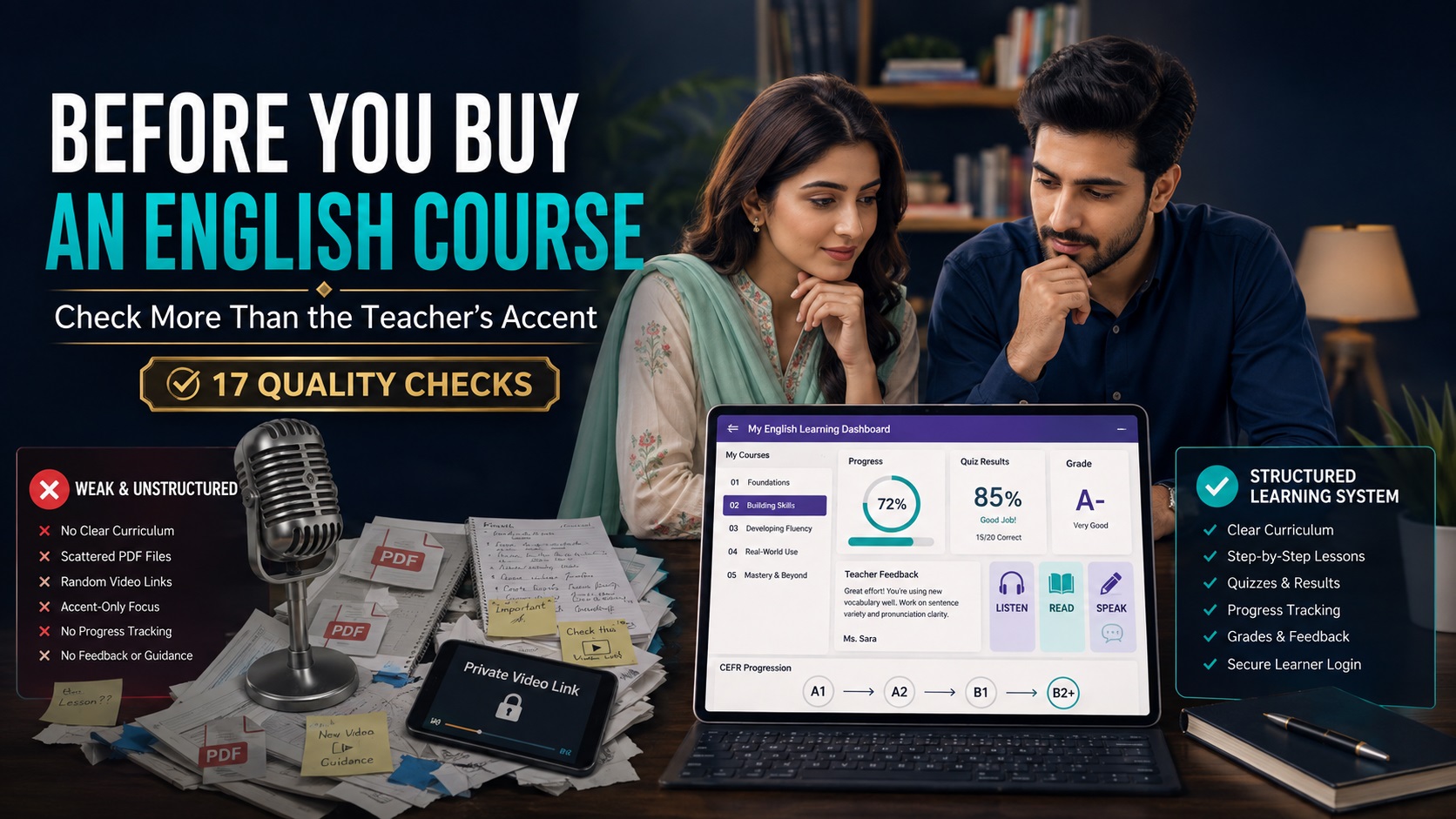
If you are wondering how to choose an English course in Pakistan, do not judge a programme only by the teacher’s accent, promotional videos or promise of fluency. Before paying, examine what the course teaches, how it measures progress, where its lessons are delivered and whether a real teacher remains involved after enrollment.
Many English-course advertisements focus on confidence, pronunciation and an impressive-sounding accent. These qualities can attract attention, but they do not prove that the programme teaches English as a complete language.
A learner may sound rehearsed during one introduction and still struggle to read instructions, write a professional message, understand unfamiliar speakers or respond without a memorised script.
The short answer: Buy an English course only after checking its curriculum, level system, four-skill coverage, learning platform, assessments, feedback, support, access policy and data security.
Why Choosing the Right English Course Matters
An English course requires more than money. It requires your time, attention, practice and trust.
A weak or unsuitable course can leave you with:
- A collection of memorised sentences.
- An artificial accent that disappears under pressure.
- Grammar knowledge you cannot use in conversation.
- Video links without a learning sequence.
- No record of completed lessons.
- No meaningful assessment of speaking or writing.
- No support when you become confused or inactive.
A well-designed course should help you understand where you are starting, what you will study, how every lesson supports the next one and what you should be able to do after completing each stage.
Accent Training Is Not the Same as Learning English
Pronunciation is an important part of spoken English. Learners should be able to produce words clearly, use understandable stress and make their meaning easy to follow.
However, pronunciation should not be confused with copying a British, American or any other fashionable accent.
International language assessments generally care about whether speech is intelligible. The listener should understand you without unreasonable effort. Your natural Pakistani identity does not need to disappear before your English can become effective.
A useful pronunciation programme should develop:
- Clear production of important sounds.
- Correct word stress.
- Understandable sentence rhythm.
- Appropriate pauses and connected speech.
- Awareness of commonly mispronounced words.
- The ability to understand more than one English accent.
An accent-heavy programme may focus excessively on:
- Imitating one teacher’s speaking style.
- Repeating dramatic pronunciation exercises.
- Making ordinary Pakistani speech sound embarrassing.
- Using accent as proof of intelligence or social status.
- Memorising customer-service scripts.
- Ignoring reading, writing and broader language development.
A regional influence—Punjabi, Sindhi, Pashto, Balochi, Urdu or otherwise—is not automatically a defect. The proper question is whether the teacher models internationally understandable pronunciation and can explain how sounds, stress and meaning work.
No responsible course should humiliate learners for their natural identity or promise that copying a foreign accent will automatically produce fluency.
IELTS and Serious Language Frameworks Measure More Than Accent
The official IELTS test contains four sections: Listening, Reading, Writing and Speaking. A candidate receives separate scores for these language skills.
You may speak confidently and still lose marks because your reading, listening or writing is weak. Similarly, a rehearsed accent cannot compensate for limited vocabulary, inaccurate grammar, poor organisation or an inability to explain ideas.
The official IELTS Academic test format confirms that all four sections contribute to the test.
The Common European Framework of Reference for Languages—CEFR—takes an even broader view. It describes language through reception, production, interaction and mediation across progressive levels from A1 to C2.
That means a CEFR-informed course should help learners do things with English, not merely sound impressive while repeating selected lines.
17 Checks Before Buying an English Course in Pakistan
1. Define What You Actually Need English For
Do not begin with the question, “Which teacher has the best accent?” Begin with your real objective.
Do you need English for:
- Daily conversation?
- A job interview?
- Workplace communication?
- Teaching?
- University education?
- IELTS preparation?
- Moving abroad?
- Professional writing?
- Greater confidence in social situations?
A three-week call-centre communication course may be useful for learning a limited script. It should not be sold as a complete language programme suitable for every academic, professional or international goal.
2. Ask to See the Complete Curriculum
A serious provider should be able to show you the learning roadmap before taking payment.
Do not accept vague statements such as:
- “We cover complete English.”
- “You will become fluent quickly.”
- “Our secret method works for everyone.”
- “We teach from basic to advanced.”
Ask for specific information:
- How many levels and lessons are included?
- What does each level teach?
- Which skills are practised?
- What must the learner complete before progressing?
- What outcome is expected after every module?
A curriculum should be visible as a sequence—not hidden behind motivational promises.
3. Check How the Provider Determines Your Starting Level
A seller should not place every person at an advanced level merely because they studied English at school. They should also not humiliate educated learners by assuming they know nothing.
A reasonable starting-level process may include:
- A short spoken introduction.
- Practical questions and follow-up responses.
- A reading or listening check.
- A brief writing sample.
- An observation of hesitation and translation habits.
- A quiz or structured placement activity.
Self-perception matters, but demonstrated performance matters more. Our guide explains why learners may need to strengthen English from the foundation even when they understand familiar language.
4. Verify What “CEFR-Aligned” Actually Means
CEFR is a language-proficiency framework. Printing “CEFR” or “A1–C2” on a poster does not automatically prove that a course follows it properly.
Ask the provider:
- Which CEFR level does each module target?
- What can-do outcomes are expected?
- How does the learner progress from one level to another?
- Are the assessments connected to level outcomes?
- Can the provider show how lesson topics fit the roadmap?
The Council of Europe describes CEFR through progressive can-do levels covering reception, production, interaction and other communication abilities.
CEFR should organise learning. It should not be used merely as a decorative badge.
5. Confirm That the Course Develops More Than Speaking
A spoken-English course may reasonably give extra attention to speaking. However, speaking depends on listening, vocabulary, reading, sentence structure and the ability to organise meaning.
A balanced language programme should include appropriate development of:
- Listening: Understanding questions, instructions and different speakers.
- Speaking: Producing clear responses and participating in interaction.
- Reading: Understanding messages, instructions and useful texts.
- Writing: Producing sentences, messages, emails and organised responses.
Cambridge English likewise emphasises the importance of developing reading, writing, listening and speaking for effective real-life communication.
Ask to see at least one example of how the course develops each relevant skill.
6. Judge Pronunciation by Intelligibility—not Performance
A polished promotional video can be rehearsed and edited. Before enrolling, listen to the teacher explaining an unfamiliar point naturally.
Consider:
- Are the words pronounced clearly?
- Is the teacher easy to understand?
- Can the teacher explain pronunciation instead of demanding imitation?
- Does the course distinguish pronunciation from accent?
- Are learners exposed to more than one understandable speaking style?
Official Cambridge speaking guidance explains that the main concern is intelligibility rather than achieving a supposedly perfect accent.
Your aim should be clear international communication—not embarrassment about sounding Pakistani.
7. Examine the Teacher’s Ability to Teach—not Merely Speak
A person can speak English well and still be unable to teach it effectively.
Good teaching requires the ability to:
- Break difficult ideas into manageable steps.
- Recognise why a learner is struggling.
- Provide appropriate examples.
- Correct errors without humiliating the learner.
- Connect one lesson to the next.
- Design meaningful practice and assessments.
- Adjust explanations for the learner’s level.
Check the teacher’s relevant qualifications and experience, but also examine the actual lesson design. A degree alone does not reveal the quality of the course, and an entertaining social-media presence does not replace teaching competence.
8. Check Whether Foundation Learners Can Follow the Teaching Pace
Physical classrooms often move according to a fixed timetable. This can be helpful for discipline and interaction, but learners who miss a point may struggle to recover while the rest of the class continues.
Before joining a physical or live online course, ask:
- Can I ask the teacher to explain something again?
- Are recordings available?
- What happens if I miss a class?
- Are revision materials provided?
- Does the teacher check whether foundation learners are following?
- Is the class size small enough for questions?
A fast-paced environment is not automatically better. Speed should match the learner’s current ability and the difficulty of the material.
9. Read the Course-Access Policy Carefully
One advantage of a recorded online course is the ability to pause, repeat and revisit difficult lessons. Physical lessons usually end when the class ends unless recordings or detailed materials are provided.
However, do not assume that every online course provides permanent access.
Ask:
- How long will I retain access?
- Does access begin on payment or first login?
- Can completed lessons be revisited?
- Will access expire after a fixed number of weeks?
- Are downloadable materials mine to keep?
- What does “lifetime access” mean if the platform or business closes?
Choose a course whose access period gives you enough time to learn responsibly. Demand the policy in writing.
10. Confirm That the Provider Uses a Real Learning Management System
A PDF containing links to private or unlisted videos is not automatically a learning management system.
Video links may deliver content, but a properly configured LMS can also organise:
- Learner accounts.
- Lessons in a defined sequence.
- Completion requirements.
- Quizzes and assignments.
- Attempt history and grades.
- Progress reports.
- Feedback and teacher communication.
- Controlled access to paid material.
Ask the provider to show you the learner dashboard. Do not rely only on screenshots of the login page.
11. Look for Lesson-by-Lesson Quizzes and Completion Rules
Watching a video does not prove that the learner understood it.
A structured course should provide regular checks such as:
- Multiple-choice questions.
- Matching activities.
- Sentence-completion tasks.
- Short written responses.
- Speaking or voice-recording activities.
- Module-review assessments.
Ask whether the learner must achieve a particular result before moving forward. A progress rule encourages active learning instead of passive video consumption.
12. Understand the Difference Between Automatic Grading and Teacher Feedback
Automatic grading is not inherently bad. It is useful for objective questions with clearly correct answers. Learners can receive immediate results and repeat practice efficiently.
However, software cannot always judge whether a spoken response is natural, whether a written argument is well organised or why a learner repeatedly hesitates.
A trustworthy course should clearly explain:
- Which activities are graded automatically?
- Which activities receive teacher review?
- Are voice recordings heard by a teacher?
- Are longer writing activities manually checked?
- How quickly is feedback normally provided?
- Can an automatic result be reviewed when necessary?
Moodle, for example, supports both automatically graded quiz questions and manual grading where teacher judgement is required.
A good course uses technology for speed and consistency while reserving human judgement for tasks that genuinely require it.
13. Ask Whether You Can See Your Own Progress
A learner should not have to guess how much of the course has been completed.
A useful progress system may show:
- Completed and remaining lessons.
- Quiz attempts and grades.
- Activities that need another attempt.
- Module-completion status.
- Progress towards the next stage.
Moodle’s official documentation confirms that completion features can show learners their progress while allowing teachers to review progress towards course completion.
Ask the provider to demonstrate the progress page before you pay.
14. Find Out Whether the Provider Notices Inactive Learners
Some course sellers remain highly attentive until payment arrives and then become difficult to contact.
Before enrolling, ask:
- Who should I contact when I become confused?
- What are the official support hours?
- Will anyone notice if I stop completing lessons?
- Does the teacher send reminders or guidance?
- Can I submit a voice note or question?
- Are support boundaries explained clearly?
A teacher cannot force an adult learner to continue. However, a responsible learning system should make inactivity visible, and the provider should explain what follow-up support is available.
Promises such as “24/7 personal support” should be treated carefully unless the provider explains who responds and within what time.
15. Inspect the Course Materials
Video should not be the only learning material.
Depending on the course objective, useful materials may include:
- Lesson notes or PDFs.
- Vocabulary and sentence banks.
- Speaking drills.
- Practice questions.
- Writing activities.
- Revision sheets.
- Audio or pronunciation support.
- Instructions for voice-recording practice.
- Quizzes and answer feedback.
Materials should support learning instead of merely repeating the video transcript.
If you study independently, read our practical guide on how to practise English speaking alone at home. It will help you judge whether the prospective course provides enough material for active practice.
16. Check How the LMS Protects Learner Information
An LMS may store names, email addresses, phone numbers, grades, quiz attempts, messages and uploaded work. Voice recordings may contain additional personal information.
No responsible provider should casually expose that information in public folders or open messaging groups.
Before enrolling, check for:
- A secure HTTPS website connection.
- An individual learner account and password.
- A functioning password-reset process.
- A privacy policy.
- Restricted access to courses and submitted work.
- A clear explanation of who can view assignments and recordings.
- A responsible method for requesting account help.
- Evidence that the platform and plugins are maintained.
A well-known LMS name does not automatically guarantee security. The installation, hosting, updates, permissions and administrator practices also matter.
Moodle’s documentation includes dedicated security recommendations and privacy controls, but the organisation operating the site must configure and maintain them responsibly.
17. Compare the Complete Value—not Just the Advertised Fee
The cheapest course is not always economical, and the most expensive course is not automatically the best.
Compare:
- Total number of structured lessons.
- Course-access duration.
- Teaching materials.
- LMS features.
- Quizzes and assessments.
- Teacher feedback.
- Live or WhatsApp support.
- Progress tracking.
- Refund and cancellation terms.
- Any additional fees.
Our detailed guide to online English speaking course fees in Pakistan explains what different course prices may include and what questions to ask before payment.
Are Physical English Institutes Bad?
No. A good physical institute can provide routine, direct interaction, immediate clarification and opportunities to speak with classmates.
The problem is not the building. The problem is an unsuitable or incomplete methodology.
A physical course may be a good choice if:
- The curriculum is clearly structured.
- The class size allows participation.
- The teacher provides meaningful correction.
- All relevant language skills are developed.
- Learners receive revision materials.
- Missed work can be recovered.
- Progress is assessed and recorded.
A physical course may be unsuitable if it moves too quickly, depends on one teacher’s preferences, provides no revision access or treats accent imitation as complete language development.
Are Recorded Online English Courses Effective?
Recorded learning can be highly useful for people who need flexibility, repetition and home access. Learners can pause difficult explanations, replay drills and study according to their available time.
But recorded lessons are only one component of a course.
An effective recorded programme should combine content with:
- A structured sequence.
- Practice activities.
- Completion requirements.
- Quizzes and grades.
- Speaking or writing tasks.
- Progress visibility.
- A defined human-support pathway.
A folder of videos may contain useful information, but information alone is not a complete learning system.
When Accent-Focused Training Can Be Useful
Accent and script training can serve a limited professional purpose. For example, a call-centre employee may need to:
- Deliver a standard greeting clearly.
- Understand common customer requests.
- Use an approved call script.
- Apply suitable tone and call etiquette.
- Pronounce product or company terms consistently.
That training can be valuable for the particular job.
However, a focused call-handling programme should not be presented as proof that the learner has developed complete English-language proficiency. Broader study may still be needed for writing, independent conversation, education, professional advancement or IELTS preparation.
Warning Signs Before You Pay
- The provider refuses to show the curriculum.
- The advertisement promises complete fluency within an unrealistic period.
- The teacher treats one foreign accent as the definition of good English.
- “CEFR-aligned” appears on the poster but no level outcomes are available.
- The course consists only of private video links.
- No learner dashboard or progress page exists.
- The seller cannot explain how quizzes are graded.
- Speaking and writing activities receive no human review.
- Support is promised but official timings are not stated.
- The provider requests unnecessary personal information.
- The privacy, access and refund policies are unavailable.
- Testimonials make extraordinary claims without explaining the learner’s starting point or work.
Questions to Send the Course Provider
Before paying, send these questions in one message:
- Can I see the complete lesson-by-lesson curriculum?
- Which level should I begin from, and how will you assess it?
- How is the course connected to CEFR levels?
- Does it develop listening, speaking, reading and writing?
- How long will I have access?
- Do you use a proper LMS with an individual account?
- Are there quizzes after each lesson?
- Which activities are automatically graded?
- Which activities receive teacher feedback?
- Can I view my progress and grades?
- What support is available if I become stuck?
- Who can see my personal information and submitted work?
- What are the payment and refund terms?
A professional provider should welcome informed questions. Clear answers protect both the learner and the institute from misunderstandings.
A Simple English-Course Buying Scorecard
Give the course one point for every statement you can verify:
- The complete curriculum is visible.
- The starting level is assessed.
- CEFR claims are supported by level outcomes.
- All relevant language skills are included.
- Pronunciation focuses on intelligibility.
- The teacher’s qualifications and teaching ability are credible.
- The pace and missed-lesson policy are clear.
- The access duration is stated in writing.
- A genuine learner dashboard exists.
- Each lesson includes meaningful practice.
- Quizzes and grading methods are explained.
- Human feedback is available where required.
- The learner can view progress.
- Support and follow-up arrangements are clear.
- Comprehensive materials are provided.
- Privacy and security information is available.
- The complete fee and refund terms are transparent.
Understanding the Score
- 14–17 points: The programme appears structured, but verify that its level and teaching style suit you.
- 10–13 points: The course may be useful, but important questions remain unanswered.
- 6–9 points: Proceed carefully and request evidence before paying.
- 0–5 points: You may be buying content or promises rather than a complete learning system.
This scorecard is a consumer guide, not an accreditation or guarantee. Use it to ask better questions.
Frequently Asked Questions
What should I look for in an English language course?
Look for a structured curriculum, appropriate starting level, balanced skill development, understandable pronunciation, regular practice, quizzes, progress tracking, meaningful feedback, clear support and transparent policies.
Is a British or American accent necessary for good English?
No. Your speech should be intelligible and appropriate for the situation. Pronunciation matters, but copying a particular national accent is not the same as developing complete language ability.
Should an English course include writing?
Writing should be included when the course promises broad English proficiency, academic preparation or professional communication. IELTS and other complete language assessments do not evaluate speaking alone.
Is an LMS necessary for an online English course?
A course can teach useful material without an LMS, but an LMS provides stronger organisation, access control, assessments, grades and progress tracking. Buyers should understand whether they are purchasing a learning system or only a collection of files and videos.
Are automatically graded quizzes useful?
Yes. They provide immediate and consistent results for objective questions. However, longer writing and speaking tasks often require human judgement and personalised feedback.
Should I demand lifetime course access?
Not every good course provides lifetime access. The important requirement is a clear written access period that gives you sufficient time to complete and revise the programme. Treat undefined “lifetime” promises carefully.
Which is better: online or physical English classes?
Neither format is automatically better. Physical classes offer direct interaction and routine. Structured online learning offers flexibility, repetition and digital progress tracking. Choose according to curriculum quality, support, assessment and your learning circumstances.
How can I test a course before enrolling?
Ask to see the curriculum, learner dashboard, sample lesson structure, assessment method and access policy. You can also complete the 30-day English speaking challenge to identify which speaking skills you need to strengthen.
Buy a Learning System—not an Accent or Collection of Links
Learning English is a long-term investment. Do not buy a course merely because the teacher sounds impressive, speaks quickly or uses a fashionable accent.
Look beyond the advertisement.
Examine the curriculum. Check the level progression. Ask about reading, writing, listening and speaking. Inspect the LMS. Understand the quizzes. Find out who reviews your work, who monitors your progress and what happens when you need help.
The best English course is not necessarily the loudest, fastest or most expensive. It is the course that gives you a clear path, meaningful practice, measurable progress and enough support to continue.
Tutor AI & English follows a progressive CEFR-aligned roadmap supported by structured lessons, learning materials, speaking drills, voice activities and LMS quizzes. Learners begin with Module 1—English Speaking Foundation and progress towards daily-life, social, professional and advanced communication.
Explore the Tutor AI & English learning pathway and compare it using the same checklist presented in this guide. An informed learner should never be afraid to ask what they are paying for.